How AI Health & Safety Apps Are Helping Families Care for Aging Loved Ones

Caring for an aging parent from another home or city often means trying to answer several questions at once. Did they take their medication? Are they following their normal routine? Did they return home safely? Has something changed that the family should know about?
Traditional apps can provide reminders, location information, or emergency alerts. An AI health app can potentially go a step further by helping interpret information, recognize patterns, and surface changes that may deserve attention.
This is where AI-powered health and safety technology is beginning to change family caregiving. Current AI applications in long-term care include monitoring, caregiver assistance, care navigation, assessment, and clinical support.
TURN EVERYDAY SENIOR HEALTH & SAFETY SIGNALS INTO SMARTER SUPPORT
Discover how mySeniorCareHub brings AI, connected safety tools, and wellness features together to help families stay informed while supporting an aging loved one’s independence.
What Is an AI Health and Safety App for Seniors?
An AI app for seniors combines digital health or safety tools with artificial intelligence that can analyze information and help turn it into more useful insights.
The important difference is context.
A basic monitoring tool might show activity or health information. AI-enabled platforms can potentially analyze patterns over time and identify changes that are different from a person’s usual routine.
Current senior-care platforms are already applying this model to areas such as activity patterns, sleep, mobility, wellness check-ins, medication adherence, and unusual behavior.
For families, the goal is not simply collecting more data. It is making the information easier to understand and act on.
How Can AI Help Families Notice Changes Earlier?
Older adults have individual routines.
One person may take a morning walk every day. Another may regularly complete a wellness check-in at 9 a.m. Someone else may follow a consistent medication schedule.
AI-based monitoring can look for changes from those established patterns. Some current platforms, for example, use AI to identify deviations in movement, sleep, bathroom visits, meals, or other routines and then alert caregivers when something unusual occurs.
That does not mean every change represents a health emergency. AI should not be treated as a diagnosis.
Instead, it can help answer a more practical caregiving question: Is there something different today that may be worth checking?
Can AI Reduce the Need to Constantly Check on an Aging Parent?
This is one of the most practical uses of an AI safety app.
Without connected technology, family caregivers may rely on repeated calls and messages simply to confirm that everything is okay. That becomes especially difficult for adult children balancing work, their own households, and long-distance caregiving.
AI-supported monitoring can help shift caregiving from constant checking toward exception-based attention. Instead of requiring someone to manually review every routine event, technology can help highlight information that may require follow-up.
Research into AI health monitoring has identified the potential to complement existing care and reduce some burden on family caregivers, although privacy, autonomy, safety, and the quality of the technology remain important considerations.
What Can an AI Companion for Seniors Actually Do?
An AI companion for seniors should be understood as more than a chatbot having conversations with an older adult.
In senior care, an AI-powered companion can connect multiple parts of everyday wellness and safety.
Depending on the platform, that might include:
- Daily wellness or safety check-ins
- Medication reminders
- Location tracking
- Geofencing or safe-zone alerts
- SOS emergency alerts
- Fall detection through connected devices
- Vital or health monitoring
- Family and caregiver notifications
Some emerging systems also use AI-powered prompts, summaries, or insights to help caregivers understand information without manually reviewing every data point.
The real value is therefore not one isolated AI feature. It is connecting information that would otherwise remain scattered across different tools.
How Can AI Improve Senior Health Monitoring?
A senior health monitoring app can bring information such as blood pressure, pulse, blood oxygen, blood glucose, medication schedules, wellness check-ins, and other supported health data into a more accessible digital experience.
AI can potentially make this information more useful by helping identify trends or changes over time.
However, families should be careful about the difference between monitoring and medical diagnosis. AI-generated health information should not replace physicians, emergency services, or professional medical judgment.
Research on AI and aging in place remains promising but evolving, and reviews have emphasized the need for continued evaluation of effectiveness, usability, privacy, and implementation.
Where Does Safety Fit Into AI-Powered Senior Care?
Health information alone cannot address every family concern.
A parent may be generally healthy but become disoriented during a walk. Someone may experience a fall. Another senior may need emergency assistance when nobody is nearby.
That is why an effective AI safety app should connect intelligence with practical safety tools.
Location tracking, geofencing, SOS alerts, fall detection, daily check-ins, and connected devices can provide the safety layer. AI can then help make the broader system more proactive by organizing information and helping identify meaningful changes.
This reflects a wider industry movement toward intelligent monitoring designed to support safer aging at home rather than relying only on reactive emergency devices.
How Is mySeniorCareHub Building an AI-Powered Health & Safety Companion?
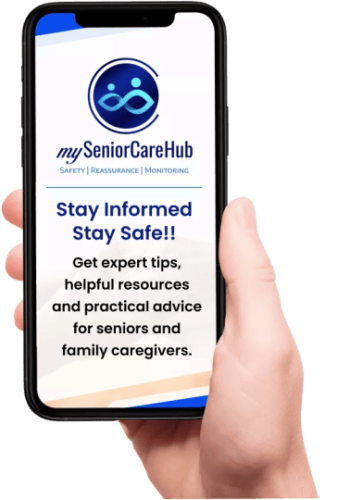
mySeniorCareHub is bringing this connected approach together as an AI-powered Health & Safety Companion for older adults, families, and caregivers.
Rather than treating health monitoring, emergency safety, and family connectivity as separate problems, the mySeniorCareHub ecosystem combines them through its app and connected SafeLynk devices.
The platform includes medication reminders, vital monitoring, daily wellness check-ins, real-time location tracking and geofencing, SOS alerts, fall detection, appointment management, and family care coordination.
Its broader AI vision is to connect health insights, safety solutions, connected devices, and family engagement so senior care can become more proactive rather than focusing only on what happens after an emergency.
For families, this means moving toward one connected companion that can support both everyday wellness and moments when additional attention may be needed.
What Should Families Look for Before Choosing an AI App for Seniors?
AI should not be the only reason to choose an app.
Families should ask what information the technology collects, how alerts are generated, who can access the information, and whether the older adult understands and agrees to the monitoring.
Ease of use is equally important. Research involving older adults has identified accessibility, digital literacy, cost, and ethical concerns as factors that can affect adoption of AI-enabled healthcare tools.
A useful solution should ultimately make caregiving simpler, not give families another complicated dashboard to manage.
AI Should Support the Family, Not Replace It
The future of senior care is not about handing caregiving over to artificial intelligence.
It is about using AI to make health and safety information more meaningful.
An AI health app can help organize wellness information. An AI safety app can help families focus on events that may require attention. Connected devices can extend protection beyond the smartphone. Families and professional caregivers still provide the judgment, conversation, reassurance, and human response.
When these pieces work together, an AI companion for seniors can become something more useful than another app. It can provide a connected layer of support that helps older adults maintain independence while giving families better information about when they may need to step in.
HELP YOUR AGING LOVED ONE STAY INDEPENDENT WITH SMARTER SUPPORT
Frequently Asked Questions (FAQs)
-
An AI companion for seniors uses artificial intelligence to support everyday needs such as reminders, wellness check-ins, health information, safety monitoring, and family connectivity. Sage Companion
-
AI can help organize health and wellness information, support daily routines, identify unusual patterns, and provide caregivers with relevant updates or alerts when attention may be needed. YORO Health
-
Depending on the app and connected devices, AI-enabled systems may monitor health signals, activity, medication routines, falls, or other safety events and share alerts with authorized caregivers.
-
Privacy depends on the individual platform. Families should review what data is collected, how it is stored, who can access it, and whether the senior controls family or caregiver access.
-
No. AI companions can assist with monitoring, reminders, information, and communication, but they do not replace hands-on care, professional medical judgment, or human companionship. Sage Companion